Collector guide
Condition and box grading: what “mint” really means
The grading words used by auction houses and sellers — Mint, Near Mint, Excellent, Good, Fair, Poor — plus MIB, MOC and the rest, explained with sources.
Facts last checked 4 October 2026
- Mint“The item is in perfect condition.”
- Near Mint“Almost perfect, any imperfections will be extremely minor.”
- Excellent“The item will have had very careful use, with only small imperfections.”
- Good“The item will have had more use, showing obvious imperfections.”
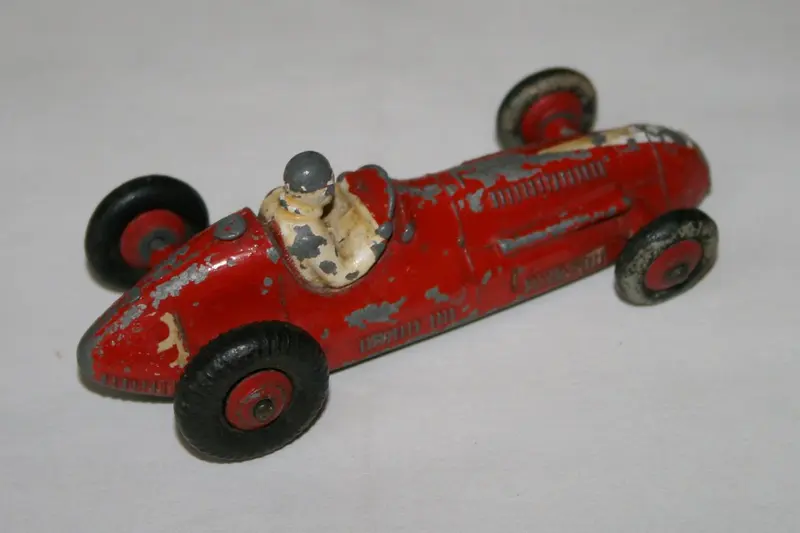
- Fair“The item will have heavy signs of wear, showing major imperfections & may include repaints.”
- Poor“The item will be in a very distressed condition, with many faults.”
Condition descriptions are opinions, not measurements — and they vary between sellers. Knowing how the professionals use the words helps you read a listing and ask the right questions. (We don’t publish valuations: what something is worth depends on its condition and on the market at the time.)
A typical auction-house scale
The scale above is the one published by Vectis, a UK toy auctioneer. Vectis adds that “Plus” may be used if an item is better than its classification suggests, that its grades relate to the appearance of an item — with no warranty for mechanical or electrical operation — and that any assessment “must be regarded as opinion only” (Vectis).
Other scales you may see
- Hake’s (a US collectibles auctioneer) adds grades between those above — Very Fine, Fine and Very Good — running from Mint (“flawless condition”) to Poor (“extensive damage and wear”) (Hake’s).
- AFA (Action Figure Authority), a third-party grading service, uses a 100-point scale and a 10-point “Unified” scale, and separates items into sealed (original, factory-sealed packaging), qualified (opened, but no signs of use) and loose (not in original packaging) (AFA).
Abbreviations in listings
Wikipedia lists the common ones (Wikipedia):
- MIB — mint in box
- MIP — mint in package
- MISB — mint in sealed box
- MOC — mint on card
- NRFB — never removed from box
Grading a toy and its box
- Ask about the box separately. A toy and its box can be in very different condition; if a listing gives one grade, ask what it refers to.
- Check completeness. Missing parts matter: FAB 1’s missiles and figures, Thunderbird 2’s pod and Thunderbird 4. Even the Science Museum Group’s 1973 Dinky FAB 1 is catalogued “Weaponry wanting” (record).
- Look for repairs and repaints. Vectis’s description of “Fair” notes that items may include repaints — see spotting reproductions and restorations.
- Electronics are separate. As Vectis notes, a grade describes appearance; ask whether sound and light features work.