Blog · · 3 min read
Which jet, which year? Matching a USAF Thunderbirds model to its era
The display team has flown seven jet types since 1953, from straight-winged F-84Gs to today's F-16s. A plain-English timeline for modellers, with the dates that matter when you choose a kit, decals or a die-cast.
Facts last checked 23 November 2026
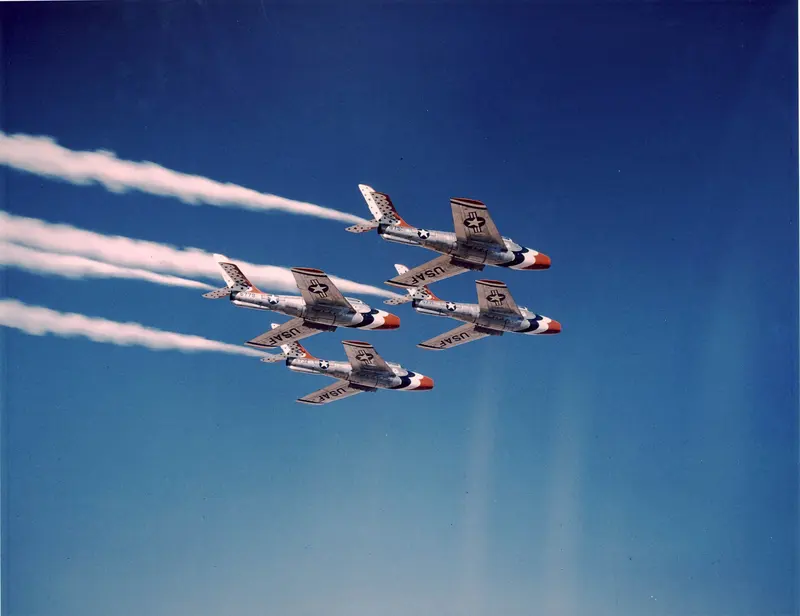
A USAF Thunderbirds model is a model of a particular aircraft in a particular year. The team's red, white and blue scheme has stayed recognisable, but the jets underneath have changed many times, and a decal sheet or a die-cast is usually tied to one type and era. Here's a simple timeline to help you match model, markings and date.
The seven jet types
1953–1955: F-84G Thunderjet. The Air Force Historical Foundation dates the team's first performance to June 1953 at Luke Air Force Base, Arizona, flying the F-84G, when it was officially the 3600th Air Demonstration Flight. Unlike its successor, the F-84G has straight wings. The Aviationist notes the team also flew a two-seat T-33 for the narrator and guests.
1955–1956: F-84F Thunderstreak. The swept-wing version replaced the F-84G in spring 1955 — the aircraft in our photo above.
1956–1968: F-100 Super Sabre. The team moved to the F-100C in 1956, which The Aviationist says made it the first aerobatic team to fly a supersonic aircraft, and later to the F-100D, flown through the 1968 season. Our timeline notes the move to Nellis Air Force Base in Nevada came in the same year.
1964: F-105B Thunderchief. A short episode: The Aviationist records only six shows in early 1964 before the team went back to the F-100. That brevity is exactly why F-105B Thunderbirds models are a collector's curiosity.
1969–1973: F-4E Phantom II. Introduced in June 1969, and painted with a white base colour. The Aviationist says the last show was in November 1973.
1974–1982: T-38 Talon. A smaller, cheaper trainer, adopted from 1974. The Aviationist records a training accident in January 1982 that killed four pilots; demonstrations resumed in 1983 with a new aircraft.
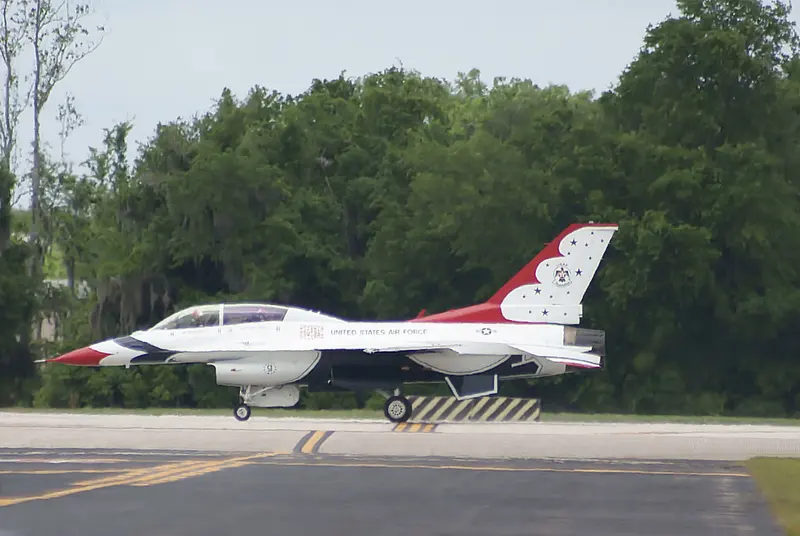
1983 onwards: F-16 Fighting Falcon. The F-16A from 1983, then the F-16C (and two-seat F-16D) from the early 1990s; The Aviationist gives 1992 for the change. The F-16C is still the team's aircraft.
Using this when you buy
- Check the type and the sub-type. An F-100C and F-100D look similar to the untrained eye; the decal sheet or die-cast description should name the version.
- Check the year on the decal sheet. Markings and serial numbers changed over the years even within one type. Our decals guide covers putting them on.
- Single-seat or two-seat? Several eras had a two-seater for the narrator or guests (T-33 early on, F-16D later), which makes a neat companion model.
- Scale. Most of the display-team die-cast on our shelves is 1:72; the kits we list come in 1:72, 1:48 and 1:144. See scales explained.
-
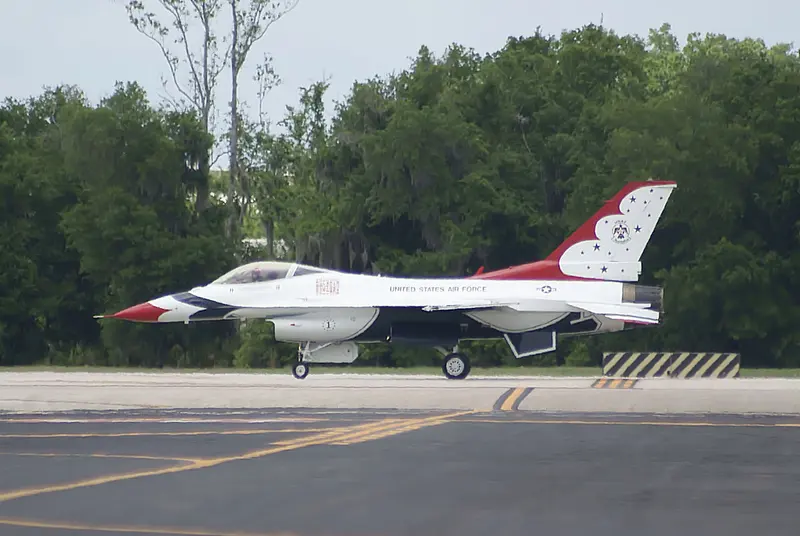
Hobby Master HA3815 F-16C Thunderbirds No. 1 (2010) A 1:72 die-cast F-16C in the markings of Thunderbird No. 1 from the 2010 season. Recent
-
Hobby Master HA38039 F-16C Thunderbirds No. 1, RIAT 2017 Thunderbird No. 1 as it appeared at the Royal International Air Tattoo in 2017. Recent
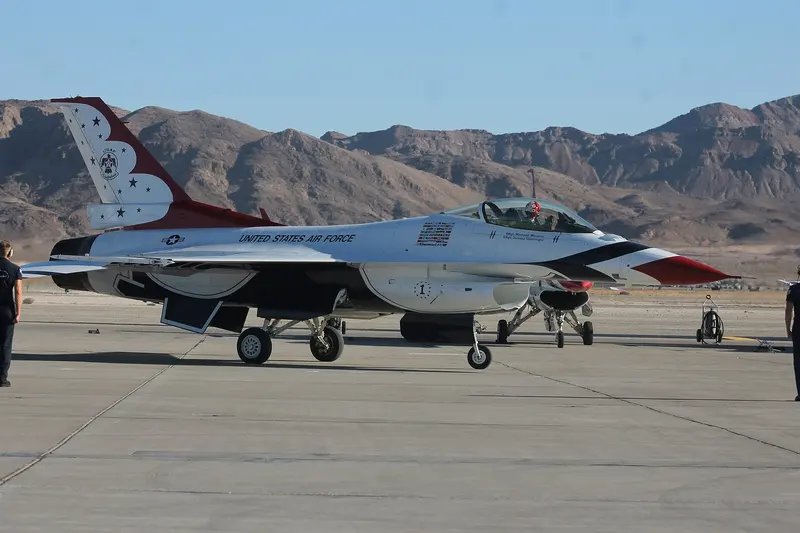
Photo: Noah Wulf, CC BY-SA 4.0
-
Hobby Master HA38044 F-16C Thunderbirds “Warbird” No. 10 (1988) A 1:72 F-16C in Thunderbirds markings as aircraft No. 10, “Warbird”, from 1988. Recent
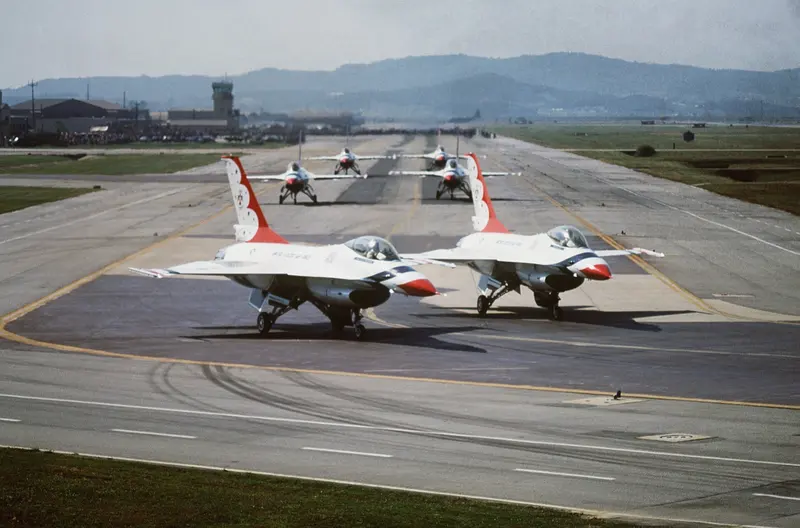
Photo: Unknown authorUnknown author, Public domain
-
Hobby Master HA19083 F-4E Phantom II Thunderbirds No. 1 (1973/74) The F-4E Phantom II in Thunderbirds markings as aircraft No. 1 — Hobby Master labels it the 1973/74 season. Recent
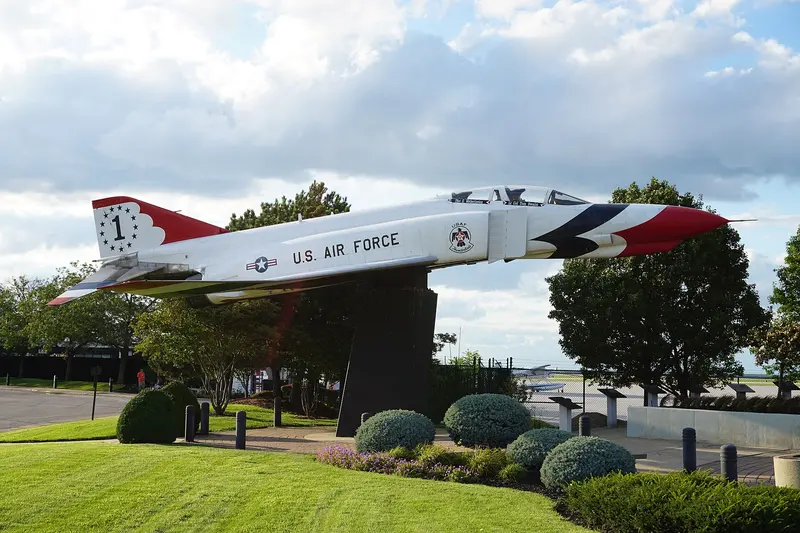
Photo: Michael Barera, CC BY-SA 4.0
Kits for a winter build
A Thunderbirds kit is a good winter project, but the polished metal and the striped scheme take patience: plenty of masking, or a good decal sheet. Our guide to building your first model kit covers the basics, and our kits shelf lists what we've found.
-
Hasegawa F-16C Block 52 Thunderbirds (1:72 kit) An injection-moulded kit of the team’s current F-16C, with a bonus patch. Current
-
Kinetic K48148 F-16D Viper “Thunderbirds” (1:48 kit) A larger 1:48 kit of the two-seat F-16D in Thunderbirds markings, with Fightertown decals. Current
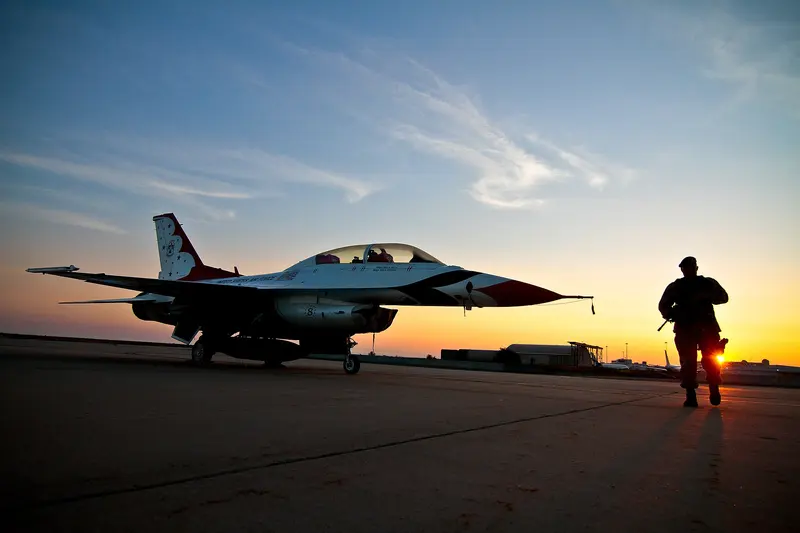
Photo: Tech. Sgt. Matt Hecht, Public domain
-
Trumpeter F-100D Super Sabre Thunderbirds (1:48 kit) The F-100D in Thunderbirds colours as a 1:48 injection kit. Current
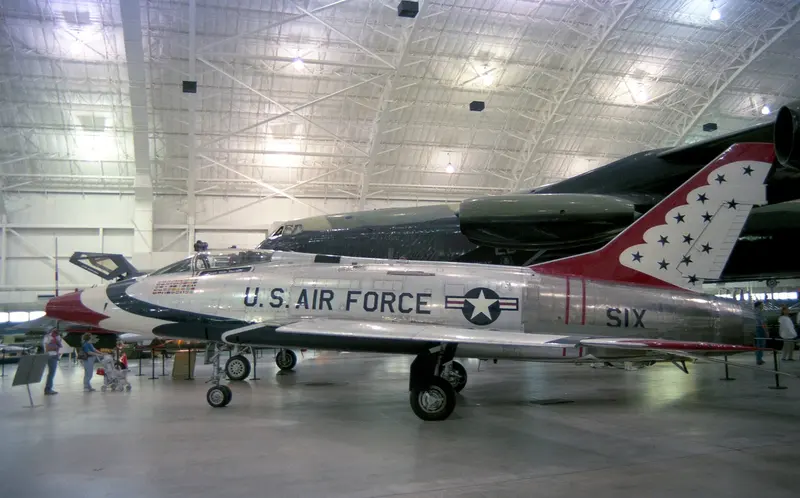
Photo: André Gerwing, CC BY-SA 4.0
-
Trumpeter T-38A Talon Thunderbirds (1:48 kit) The T-38A trainer the team flew from 1974, as a 1:48 injection kit. Current
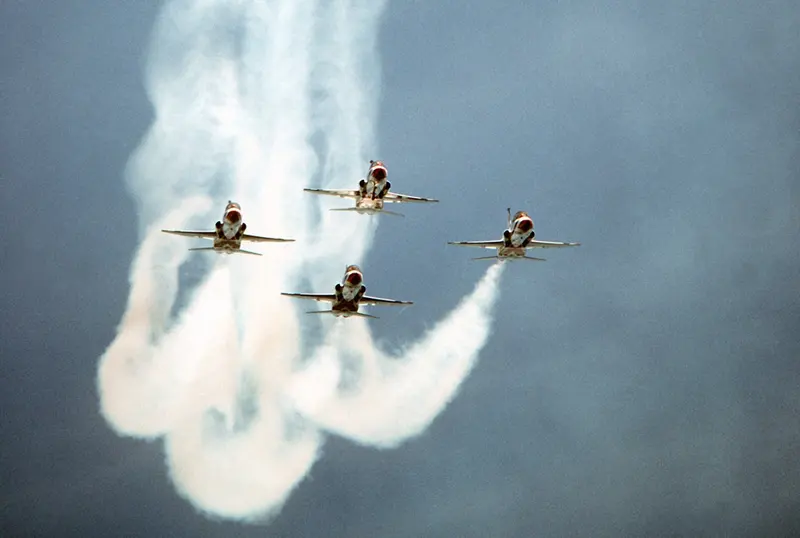
Photo: Bill Stepehnson, USAF, Public domain
Not to be confused with...
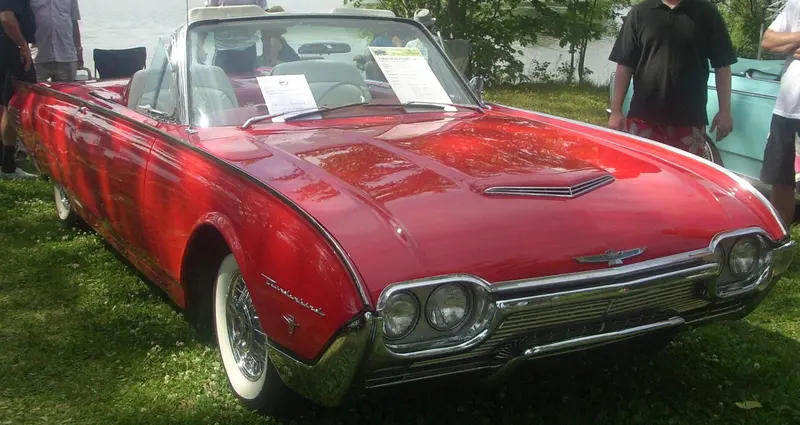
The display team is one of three "Thunderbirds" on this site. If a search throws up puppet-show craft or 1950s convertibles, see our guide to the three Thunderbirds, and our post on telling Ford Thunderbird model years apart.
?> Building a set of the team's aircraft in one scale makes a striking shelf: the change from the stubby F-84G to the F-16 shows seventy years of jet design in a few feet.
Sources
Checked 23 November 2026. Written in our own words from:
- Air Force Historical Foundation — June 8, 1953 (Thunderbirds' first performance) (afhistory.org)
- The Aviationist — Thunder in the heavens: a brief history of the aircraft of the USAF Thunderbirds (February 2025) (theaviationist.com)
Spotted something wrong or out of date? Tell us.